

What if you could manage your Meta ad campaigns just by chatting with AI instead of spending hours inside Ads Manager?
That’s exactly why Meta Ads AI Connectors are creating so much buzz in the digital marketing world. Tasks that normally take marketers hours like performance analysis, campaign reporting, optimization checks, and troubleshooting, can now potentially be handled through simple natural language prompts using AI tools like ChatGPT and Claude.
For advertisers, agencies, and growing businesses, this is more than just another platform update, it’s a major shift in how paid advertising may be managed going forward.
But does it actually work as promised?
Is it safe to give AI access to your ad account?
And can it genuinely improve campaign performance, or is it just hype?
In this complete guide, we’ll break down how Meta Ads AI Connectors work, what they can do, how to connect them, the risks involved, and whether they’re worth using for your advertising strategy.
What Are Meta Ads AI Connectors?
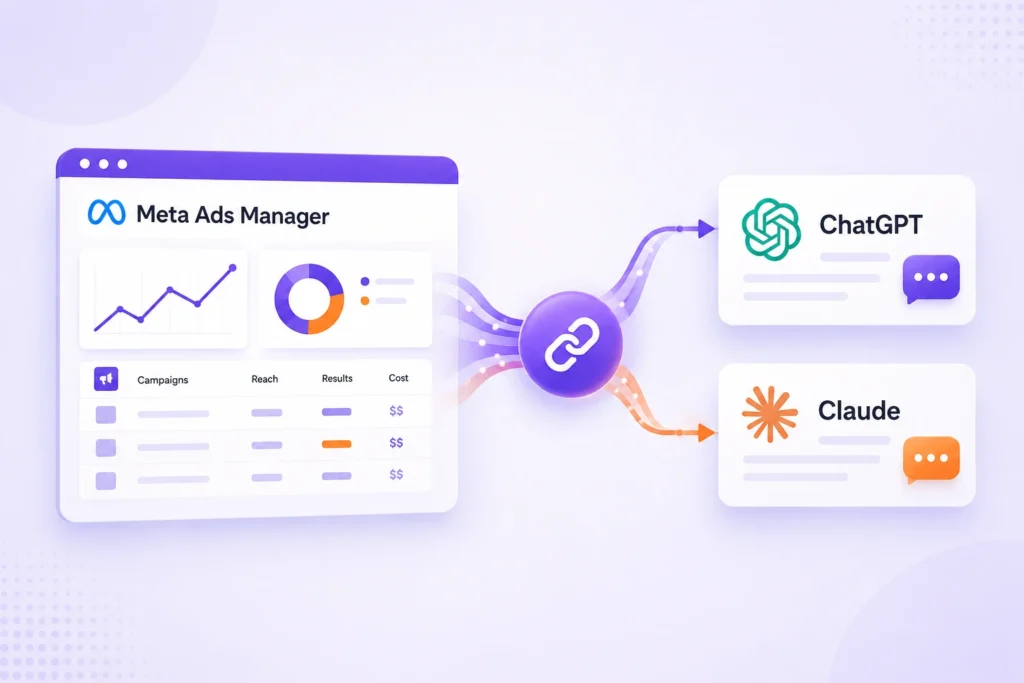
Meta Ads AI Connectors are a new integration that allows advertisers to connect Meta Ads Manager with AI tools like ChatGPT and Claude for campaign management, reporting, diagnostics, and optimization.
Instead of manually navigating dashboards, downloading reports, or making repetitive updates, marketers can interact using natural language prompts.
This changes how advertisers work because campaign management becomes faster, more conversational, and significantly less technical. A marketer can ask AI to analyze performance trends, identify weak ad sets, or explain why conversion costs are rising.
This is especially useful for businesses managing Facebook and Instagram campaigns at scale, agencies handling multiple accounts, and performance marketers looking to reduce manual effort.
- Reduces repetitive campaign management tasks
- Makes reporting faster and easier
- Helps marketers make quicker optimization decisions
- Improves workflow efficiency for advertisers
Why This Update Matters for Advertisers
AI for Meta Ads management is not just another feature update. It represents a shift toward automation-assisted advertising workflows.
Traditionally, ad managers spend hours switching between dashboards, spreadsheets, analytics tools, and creative platforms. With conversational AI integration, many of these tasks become prompt-driven.
For example, instead of manually checking campaign performance, an advertiser can simply ask AI to compare this week’s results with last week’s and highlight major performance changes.
This improves operational efficiency while freeing time for strategy, creative testing, and audience planning.
- Saves time on repetitive ad tasks
- Simplifies campaign analysis
- Helps smaller teams compete efficiently
- Makes advanced tools easier for non-technical users
How Meta Ads AI Integration Works
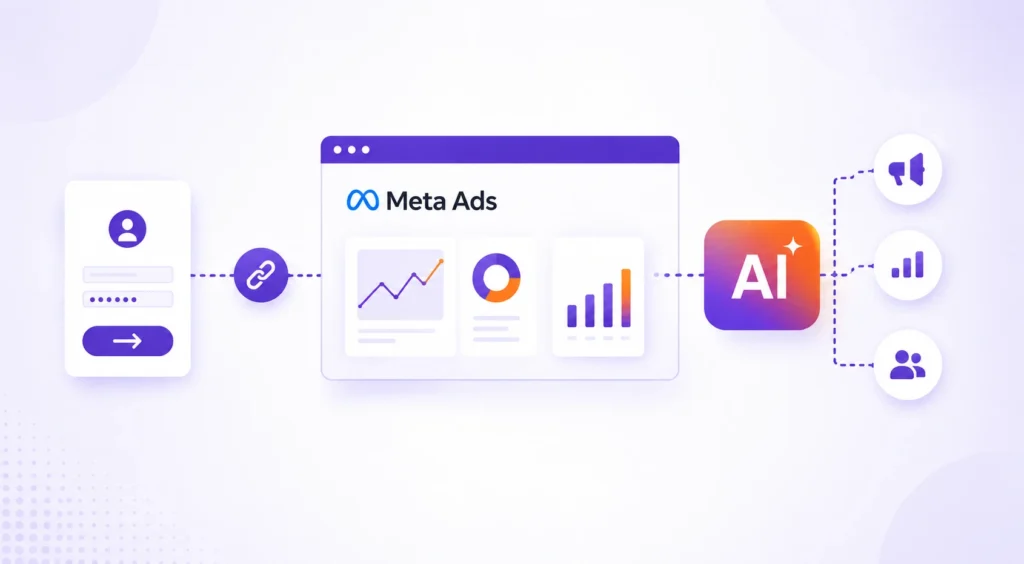
AI Connector Setup Process
The integration works by securely connecting Meta Ads accounts to approved AI interfaces using authentication permissions. Once access is granted, the AI can retrieve campaign insights and perform selected management actions.
The workflow is simple. The AI acts as an interface layer between the advertiser and Meta Ads systems.
Basic process:
- Connect your Meta Ads account
- Authenticate permissions securely
- Select approved business assets
- Enable supported AI integration
- Start using prompt-based campaign commands
What AI Can Actually Do
AI-powered ad campaign management supports multiple real-world tasks that marketers perform daily.
These include campaign reporting, performance analysis, budget review, audience diagnostics, and identifying delivery problems.
Potential use cases include:
- Analyze campaign performance trends
- Compare ad set efficiency
- Detect CPM spikes
- Review click-through rates
- Identify weak creatives
- Suggest optimization opportunities
- Monitor pixel or tracking concerns
Key Benefits of Using AI for Meta Ads Management
Faster Reporting and Performance Insights
Reporting often consumes unnecessary time. Marketers frequently export CSV files, clean spreadsheets, and manually compare performance periods.
AI removes much of that friction by generating instant summaries and actionable interpretations.
Instead of raw data overload, users get understandable insights.
Benefits include:
- Faster weekly reporting
- Easier executive summaries
- Better performance visibility
- Reduced manual spreadsheet work
Smarter Optimization Decisions
Optimization improves when data interpretation becomes faster.
AI can help surface trends humans may overlook, such as frequency fatigue, rising acquisition costs, or sudden conversion drops.
That does not replace strategic thinking, but it supports faster decision-making.
Optimization support may include:
- Budget reallocation suggestions
- Creative fatigue detection
- Audience overlap insights
- Campaign inefficiency identification
Better Workflow Efficiency
Agencies and in-house teams often manage multiple campaigns simultaneously.
AI-powered Meta Ads automation reduces context switching and operational fatigue.
Efficiency gains include:
- Faster account reviews
- Reduced repetitive clicks
- Better team productivity
- More time for strategic work
Risks and Limitations You Should Know
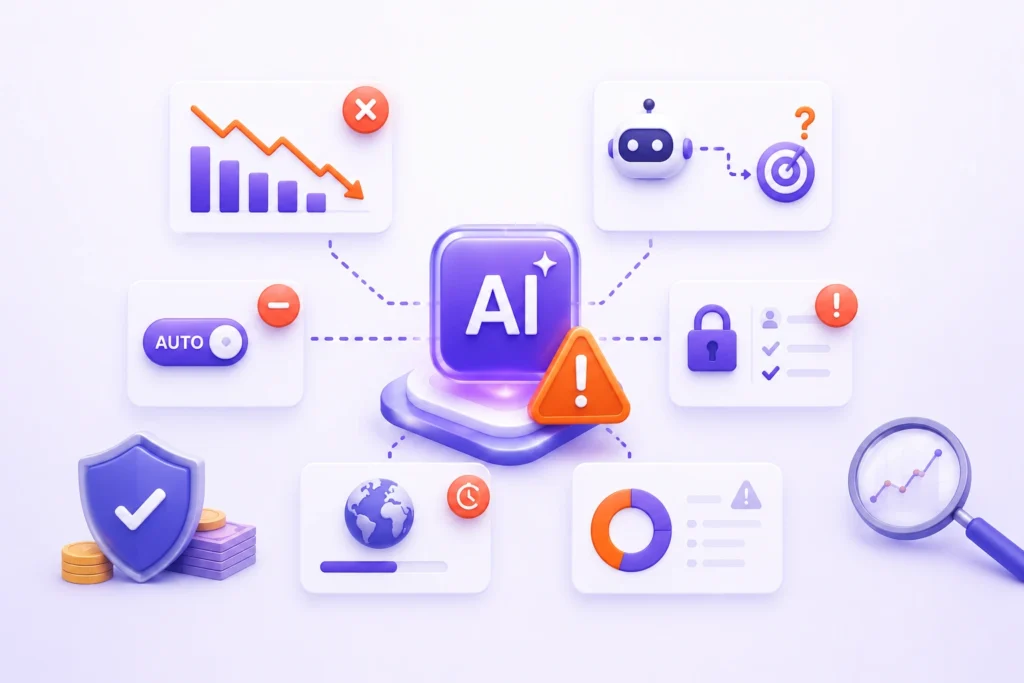
AI advertising tools are powerful, but they are not perfect.
Blind automation creates risk. Advertisers still need oversight, especially when budgets are involved.
AI may misunderstand prompts, misinterpret context, or provide incomplete recommendations.
Platform limitations also matter because some features may still be in beta rollout.
Key concerns:
- Incorrect optimization recommendations
- Over-reliance on automation
- Permission management risks
- Limited rollout access
- Reporting interpretation errors
Experienced marketers should treat AI as an assistant, not a replacement.
EEAT Perspective: Why Trust Matters
Experience
Real advertisers understand campaign volatility, attribution delays, and audience behavior shifts. AI-generated recommendations must be validated against practical advertising experience.
Expertise
Understanding Meta Ads strategy still requires expertise in bidding, creatives, targeting, conversion tracking, and campaign structure.
Authoritativeness
Businesses should rely on official platform guidance, tested workflows, and experienced media buying judgment instead of hype.
Trustworthiness
Secure authentication, access permissions, and transparent oversight are essential when using AI for campaign management.
EEAT matters because search engines increasingly prioritize trustworthy, user-first content over trend-chasing speculation.
- Validate AI recommendations
- Review permissions carefully
- Maintain strategic human oversight
- Prioritize secure implementation
Who Should Use Meta Ads AI Connectors?
Meta Ads AI Connectors can be useful for many advertisers, but they deliver the most value to professionals and businesses that actively manage campaigns and need faster insights, quicker reporting, and more efficient optimization workflows.
Agencies Managing Multiple Client Accounts
For digital marketing agencies, managing multiple client campaigns often means constantly switching between ad accounts, preparing performance reports, monitoring budgets, checking campaign health, and responding quickly to client requests.
This process can become time-consuming, especially when teams handle several accounts at once. Meta Ads AI Connectors can help agencies streamline repetitive tasks by making campaign analysis faster and reporting more efficient.
Instead of spending hours manually gathering data, teams can use AI-powered prompts to quickly review performance trends, identify weak campaigns, and focus more on strategy, creative testing, and client growth.
Small Business Owners with Limited Marketing Resources
Small business owners often run Facebook and Instagram ads without a full marketing team or dedicated paid ads specialist. For them, Meta Ads Manager can sometimes feel overwhelming due to the number of metrics, settings, and optimization decisions involved.
AI integration can simplify this experience by helping business owners understand campaign performance in a more user-friendly way.
Instead of manually interpreting complex reports, they can get faster insights, clearer explanations, and quicker recommendations, making ad management less intimidating and more manageable.
Performance Marketers Focused on Optimization
Performance marketers rely heavily on data and speed. Their day-to-day work involves monitoring key advertising metrics such as click-through rates, return on ad spend, cost per acquisition, audience engagement, frequency, and conversion trends.
Since optimization decisions often need to be made quickly, AI-powered Meta Ads management can become a valuable support tool.
It can help surface performance patterns faster, highlight unusual campaign behavior, and reduce the time spent manually digging through data, allowing marketers to move more quickly on testing and optimization opportunities.
Ecommerce Brands Running Frequent Promotions
Ecommerce businesses are one of the strongest use cases for Meta Ads AI Connectors because their advertising environment changes rapidly.
Product launches, seasonal campaigns, flash sales, retargeting campaigns, abandoned cart recovery, and promotional offers all require constant monitoring and quick adjustments.
In such fast-moving environments, delayed insights can directly impact revenue. AI-assisted campaign management can help ecommerce teams detect sudden performance drops, identify underperforming creatives, monitor rising ad costs, and react faster to changes that affect conversions and sales growth.
Best Practices for Using AI with Meta Ads
AI can significantly improve how advertisers manage Meta campaigns, but getting meaningful results depends on how strategically you use it. Simply connecting AI to your advertising workflow does not automatically guarantee better performance.
Like any advanced tool, its effectiveness depends on clear instructions, proper oversight, and responsible usage. The smartest advertisers use AI as a decision-support assistant rather than a fully independent campaign manager.
Following best practices can help you improve efficiency while reducing risks.
Be Specific with Your Prompts
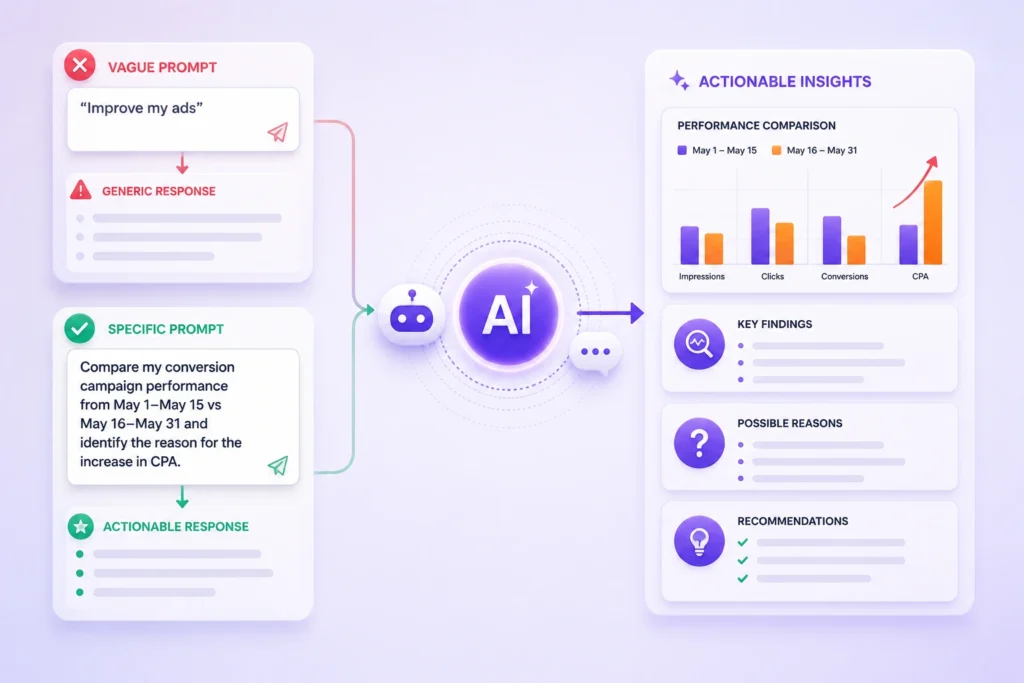
The quality of AI-generated insights depends heavily on the quality of the prompts you provide.
Vague instructions like “improve my ads” or “fix my campaign” usually produce generic recommendations that may not be useful. Instead, advertisers should ask clear, focused questions tied to specific campaign goals or performance issues.
For example, comparing campaign performance over a defined time period, identifying sudden CPA increases, or analyzing audience engagement will generate far more actionable insights.
Specific prompts help AI understand context better and produce more relevant responses.
Review Recommendations Before Taking Action
AI can process data quickly, but it does not fully understand your business goals, customer behavior, seasonality, or brand strategy the way a human marketer does.
That’s why every recommendation should be reviewed before implementation. Automatically approving budget changes, campaign pauses, or optimization suggestions without human validation can lead to costly mistakes.
AI should support decision-making, not replace strategic judgment. Experienced advertisers always verify suggestions against actual campaign objectives before acting.
Protect Account Permissions and Access
Security should be a top priority when integrating AI with advertising platforms. Since Meta ad accounts involve budgets, customer data, and business assets, advertisers should only grant the minimum permissions required for the intended workflow.
Avoid unnecessary write access if you only need reporting or analysis support. Teams should also regularly review authentication permissions, account access controls, and connected integrations to reduce security risks.
Responsible access management builds trust and protects advertising operations.
Combine Human Strategy with AI Efficiency
AI excels at speed, data summarization, and identifying patterns, but successful advertising still depends on human creativity, strategic thinking, and business understanding.
Campaign messaging, audience psychology, creative direction, and growth decisions require human expertise. The most effective approach is to use AI for operational efficiency while keeping strategic control with experienced marketers.
This creates a balanced workflow where technology accelerates execution without compromising decision quality.
Best Practice Checklist:
- Use clear and goal-specific prompts
- Validate recommendations before implementation
- Monitor campaign performance regularly
- Restrict unnecessary account permissions
- Keep strategic decision-making human-led
- Use AI to support efficiency, not replace expertise
Frequently Asked Questions
Can ChatGPT manage Meta Ads campaigns?
AI can assist with reporting, analysis, diagnostics, and workflow support depending on integration permissions. Strategic oversight should remain human-led.
Is Meta Ads AI integration safe?
It can be safe when secure authentication, proper permissions, and human review processes are followed.
Will AI replace media buyers?
No. AI improves efficiency, but campaign strategy, creative judgment, and business decision-making still require human expertise.